How to follow ASTM D638 for plastics tensile testing step by step
ASTM D638 is the internationally recognized standard method for determining the tensile properties of plastics. Whether you're testing materials for product development, regulatory compliance, or quality control, understanding and correctly applying this method is essential for accurate, consistent results.
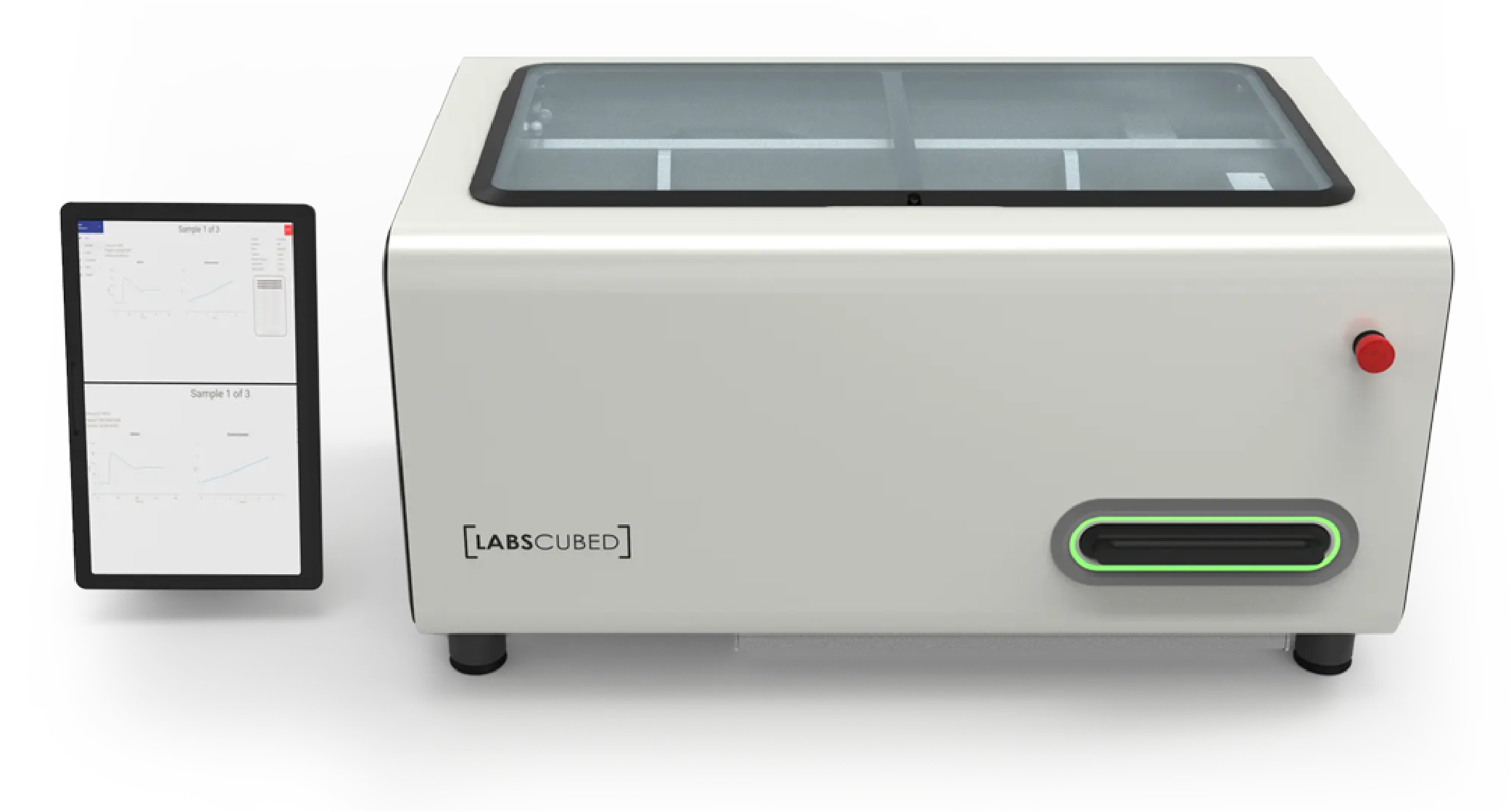
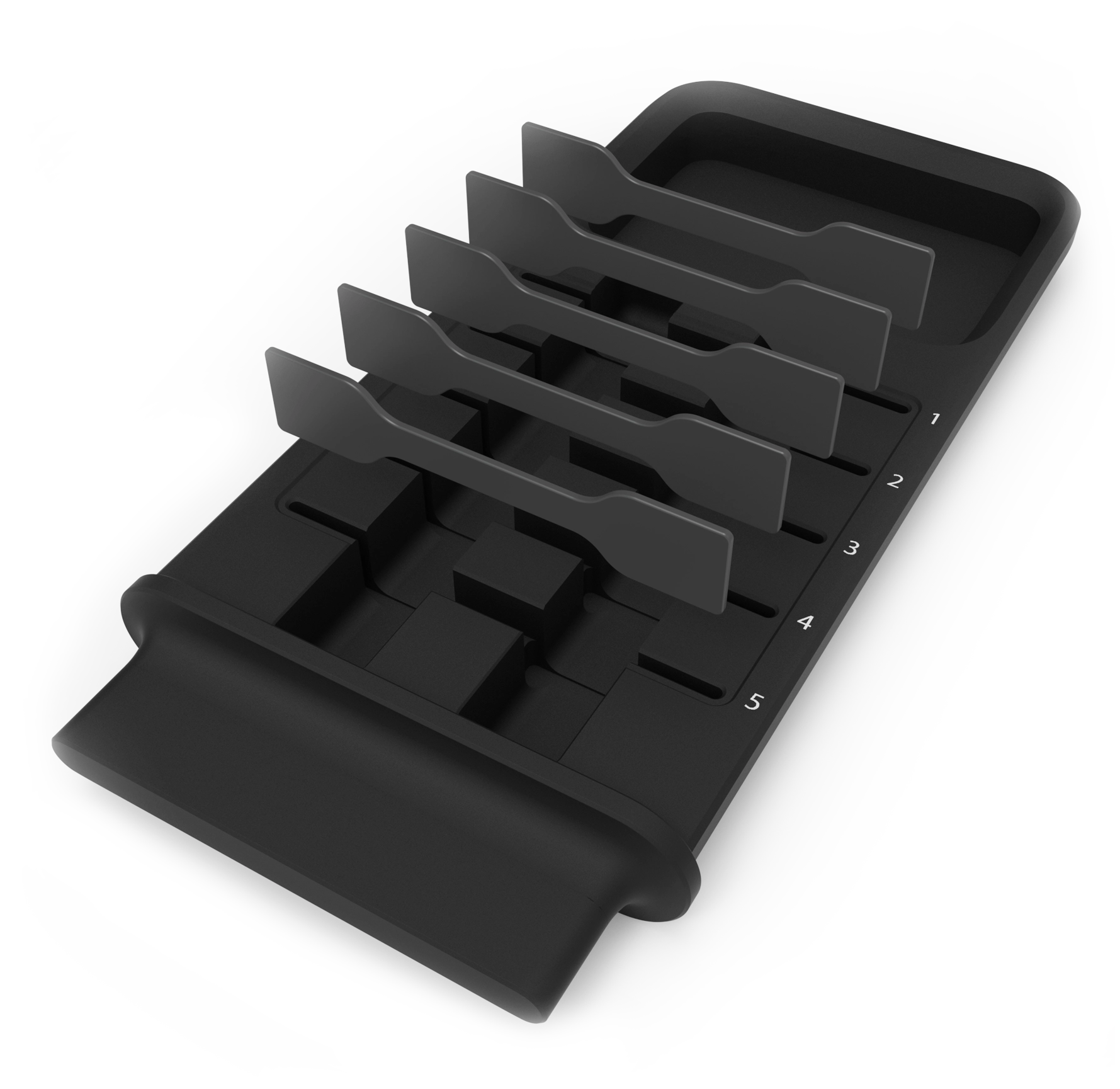
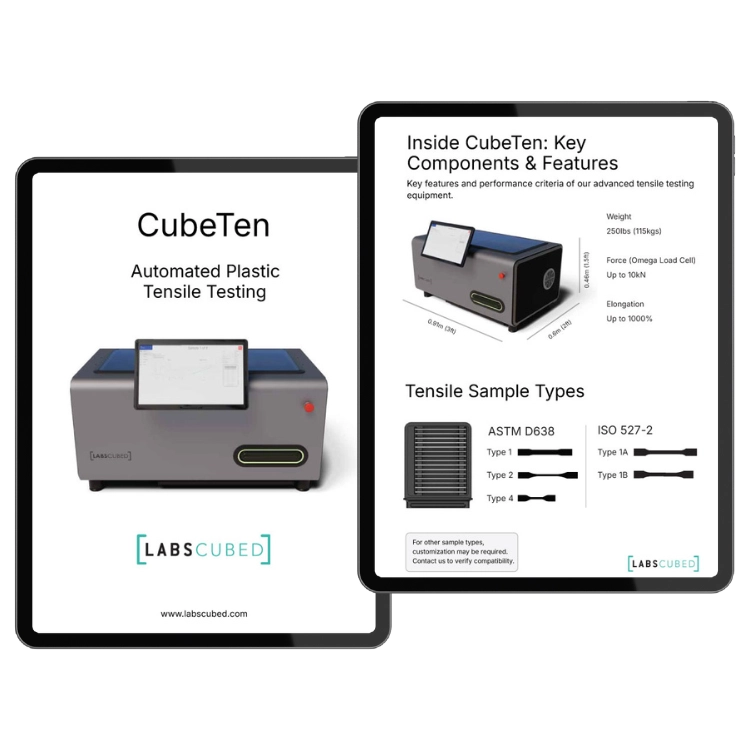
This comprehensive guide walks you through the full D638 testing process, including specimen setup, testing equipment, extensometer options, material compatibility, and the data you can expect to collect. It also includes integrated examples of how CubeTen automates and improves each step.
Official Standard: Click here
What Does ASTM D790 Measure?
ASTM D638 is used to generates a flexural Stress vs. Strain curve. From this data, the following key properties are calculated:
- Flexural Stress:
The internal stress created in the material at a given point during the bend. - Flexural Strain:
The deformation (change in length) in the outer surface of the specimen at a given stress level. - Flexural Modulus (Modulus of Elasticity in Bending):
This is a measure of the material's stiffness (rigidity). It represents the material's ability to resist elastic deformation under bending forces. This is calculated from the slope of the initial, straight-line portion of the stress-strain curve. - Flexural Strength:
Yield strain is the amount of strain a material experiences at the yield point. It marks the transition from elastic (reversible) to plastic (permanent) deformation. Beyond this, the material won’t return to its original shape. - Stress-strain behavior
The material's ability to resist the stress at the point when it yields (starts to deform permanently) or, for brittle materials, when it fractures.
This data helps engineers, product designers, and quality assurance teams ensure that materials meet performance expectations under load.
When Should You Use ASTM D790 or ISO 178?
Both ASTM D790 (American Society for Testing and Materials) and ISO 178 (International Organization for Standardization) are the primary global standards for determining the flexural properties of plastics.
- ASTM D790: This standard is widely used in North America and is a foundational method for characterizing plastic stiffness and strength. It offers two main testing procedures (Method A for slower rates and Method B for faster rates, often used for quality control).
- ISO 178: This standard is preferred in Europe and by international companies. While the principles are like D790, there are differences in the specific testing speeds, deflection limits, and calculations.
Choosing which standard to use usually depends on the geographic market where the product will be sold or the requirements of the customer. By following these procedures, engineers can ensure that the test results are reliable and comparable across different studies/materials and applications.
ASTM D790 Test Specimens
The sample shape is always a simple rectangular bar. Common dimensions are a width of 12.7 mm, thickness of 3.2mm and length of 127mm. The exact dimensions can vary based on the material's thickness, where ASTM D790 defines specimens as:
- Standard Specimen: A specimen that is 3.2 mm (0.125 in) thick. This thickness is often preferred for general comparison.
- Non-Standard Specimens: Used for materials thicker or thinner than the standard, but the span-to-depth ratio (the distance between the two supports divided by the thickness of the sample) must be maintained. For ASTM D790, this ratio is typically set at 16:1
ISO 178 Test Specimens
The ISO 178 standard for 3-point bending tests specifies a preferred bar specimen with dimensions of 80 mm (± 2 mm) long, 10 mm (± 0.2 mm) wide, and 4 mm (± 0.2 mm) thick.
How to Perform a Flexural Test (3-Point Bending Test)
The test procedure is outlined below, and shown in Figure X:
Measure Specimen
Accurately measure the width and thickness of the rectangular specimen.
Set Span
Adjust the distance between the two support anvils to achieve the required span-to-depth ratio (e.g., 16:1 for D790 Method A).
Place Specimen
Center the specimen on the two supports.
Apply Load
The loading pin is driven downward at a specified rate (as defined by the standard) applying force to the center of the span.

This workflow removes operator variability and dramatically reduces time per test, while ensuring full compliance with ASTM and ISO testing standards.
Record Data
The UTM continuously records the applied load and the resulting deflection.
This workflow removes operator variability and dramatically reduces time per test, while ensuring full compliance with ASTM and ISO testing standards.
Stop Test
The test stops when the specimen fractures, or when the strain reaches a specified limit (often 5.0% in D790) if the material is too flexible to break.
This workflow removes operator variability and dramatically reduces time per test, while ensuring full compliance with ASTM and ISO testing standards.
Calculate Results
The recorded load and deflection data, combined with the specimen's dimensions, are used to calculate the Flexural Modulus and Flexural Strength.
This workflow removes operator variability and dramatically reduces time per test, while ensuring full compliance with ASTM and ISO testing standards.
How to follow ASTM D638 for plastics tensile testing step by step
ASTM D638 is the internationally recognized standard method for determining the tensile properties of plastics. Whether you're testing materials for product development, regulatory compliance, or quality control, understanding and correctly applying this method is essential for accurate, consistent results.
This comprehensive guide walks you through the full D638 testing process, including specimen setup, testing equipment, extensometer options, material compatibility, and the data you can expect to collect. It also includes integrated examples of how CubeTen automates and improves each step.
Official Standard: Click here
What Does ASTM D790 Measure?
ASTM D638 is used to generates a flexural Stress vs. Strain curve. From this data, the following key properties are calculated:
- Flexural Stress:
The internal stress created in the material at a given point during the bend. - Flexural Strain:
The deformation (change in length) in the outer surface of the specimen at a given stress level. - Flexural Modulus (Modulus of Elasticity in Bending):
This is a measure of the material's stiffness (rigidity). It represents the material's ability to resist elastic deformation under bending forces. This is calculated from the slope of the initial, straight-line portion of the stress-strain curve. - Flexural Strength:
Yield strain is the amount of strain a material experiences at the yield point. It marks the transition from elastic (reversible) to plastic (permanent) deformation. Beyond this, the material won’t return to its original shape. - Stress-strain behavior
The material's ability to resist the stress at the point when it yields (starts to deform permanently) or, for brittle materials, when it fractures.
This data helps engineers, product designers, and quality assurance teams ensure that materials meet performance expectations under load.
When Should You Use ASTM D790 or ISO 178?
Both ASTM D790 (American Society for Testing and Materials) and ISO 178 (International Organization for Standardization) are the primary global standards for determining the flexural properties of plastics.
- ASTM D790: This standard is widely used in North America and is a foundational method for characterizing plastic stiffness and strength. It offers two main testing procedures (Method A for slower rates and Method B for faster rates, often used for quality control).
- ISO 178: This standard is preferred in Europe and by international companies. While the principles are like D790, there are differences in the specific testing speeds, deflection limits, and calculations.
Choosing which standard to use usually depends on the geographic market where the product will be sold or the requirements of the customer. By following these procedures, engineers can ensure that the test results are reliable and comparable across different studies/materials and applications.
ASTM D790 Test Specimens
The sample shape is always a simple rectangular bar. Common dimensions are a width of 12.7 mm, thickness of 3.2mm and length of 127mm. The exact dimensions can vary based on the material's thickness, where ASTM D790 defines specimens as:
- Standard Specimen: A specimen that is 3.2 mm (0.125 in) thick. This thickness is often preferred for general comparison.
- Non-Standard Specimens: Used for materials thicker or thinner than the standard, but the span-to-depth ratio (the distance between the two supports divided by the thickness of the sample) must be maintained. For ASTM D790, this ratio is typically set at 16:1
ISO 178 Test Specimens
The ISO 178 standard for 3-point bending tests specifies a preferred bar specimen with dimensions of 80 mm (± 2 mm) long, 10 mm (± 0.2 mm) wide, and 4 mm (± 0.2 mm) thick.
How to Perform a Flexural Test (3-Point Bending Test)
The test procedure is outlined below, and shown in Figure X:
Equipment Requirements
A universal testing machine (UTM) is required, equipped with the following specific tools:
- Loading Fixture: A 3-point bend fixture consisting of a loading nose (the punch that applies the force) and two support anvils (where the sample rests).
- Load Cell: To accurately measure the applied force.
- Deflection Measurement: A system (often an extensometer or a calculated crosshead displacement with compliance correction) is needed to precisely measure how much the center of the specimen deflects (moves downward) during the test.
- Precision Tools: Micrometers and calipers are needed to accurately measure the specimen's width and thickness before testing, as these dimensions are critical for calculating stress and strain.
Can this test be done horizontally? Is there any impact on the data?
CubeTen supports three extensometer technologies — all optimized to meet the accuracy and compliance requirements of ASTM D638 and the equivalent international standard, ISO 527.
Flexural testing, governed by standards like ASTM D790 and ISO 178, is essential for selecting plastics for parts that need stiffness and strength, like casings or shelves. Understanding the 3-point bending method and its specific requirements ensures reliable data. By accurately measuring properties like Flexural Modulus, engineers can confidently select the right material, ultimately leading to more durable and safer products.
Equipment Requirements
A universal testing machine (UTM) is required, equipped with the following specific tools:
- Loading Fixture: A 3-point bend fixture consisting of a loading nose (the punch that applies the force) and two support anvils (where the sample rests).
- Load Cell: To accurately measure the applied force.
- Deflection Measurement: A system (often an extensometer or a calculated crosshead displacement with compliance correction) is needed to precisely measure how much the center of the specimen deflects (moves downward) during the test.
- Precision Tools: Micrometers and calipers are needed to accurately measure the specimen's width and thickness before testing, as these dimensions are critical for calculating stress and strain.
Flexural testing, governed by standards like ASTM D790 and ISO 178, is essential for selecting plastics for parts that need stiffness and strength, like casings or shelves. Understanding the 3-point bending method and its specific requirements ensures reliable data. By accurately measuring properties like Flexural Modulus, engineers can confidently select the right material, ultimately leading to more durable and safer products.


.webp)
.webp)
