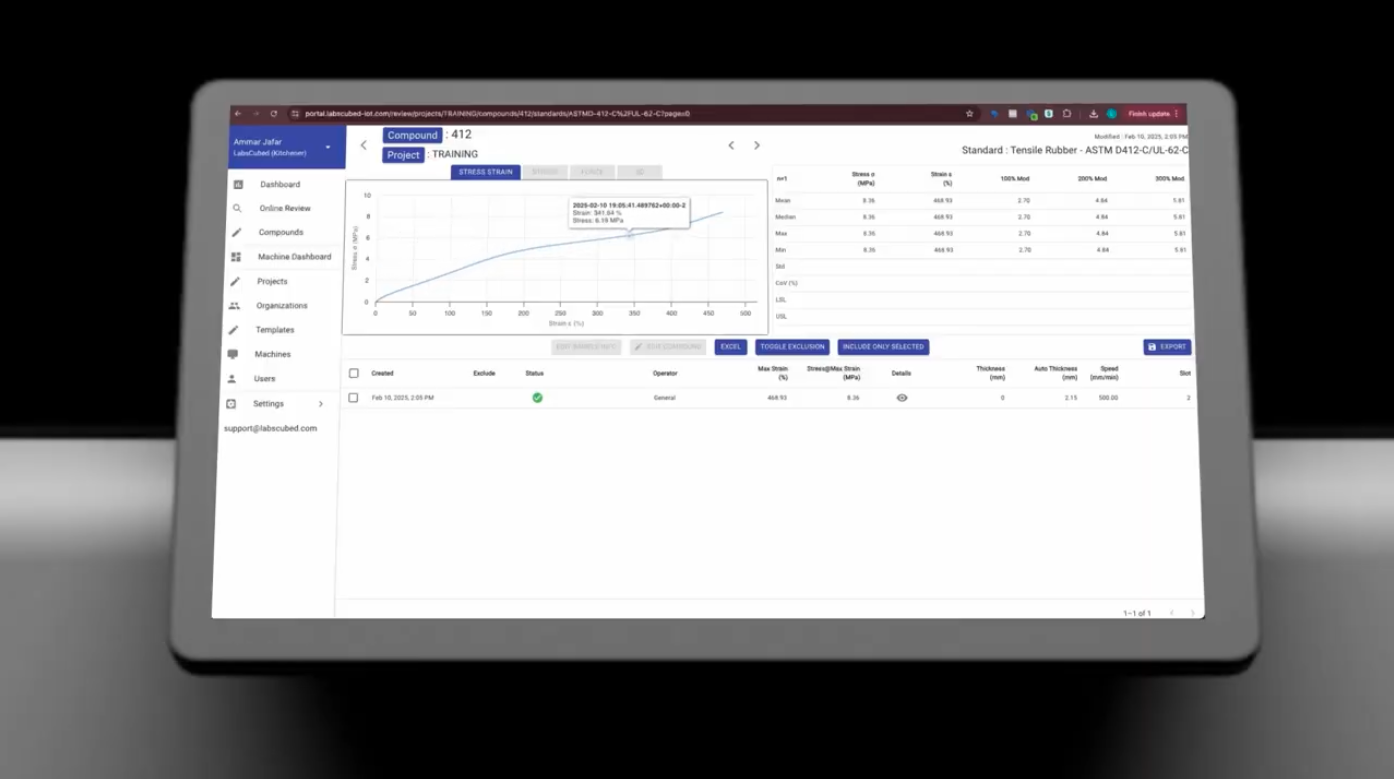
.webp)


Fatigue Testing in Rubber Compounds: Understanding Long-Term Performance
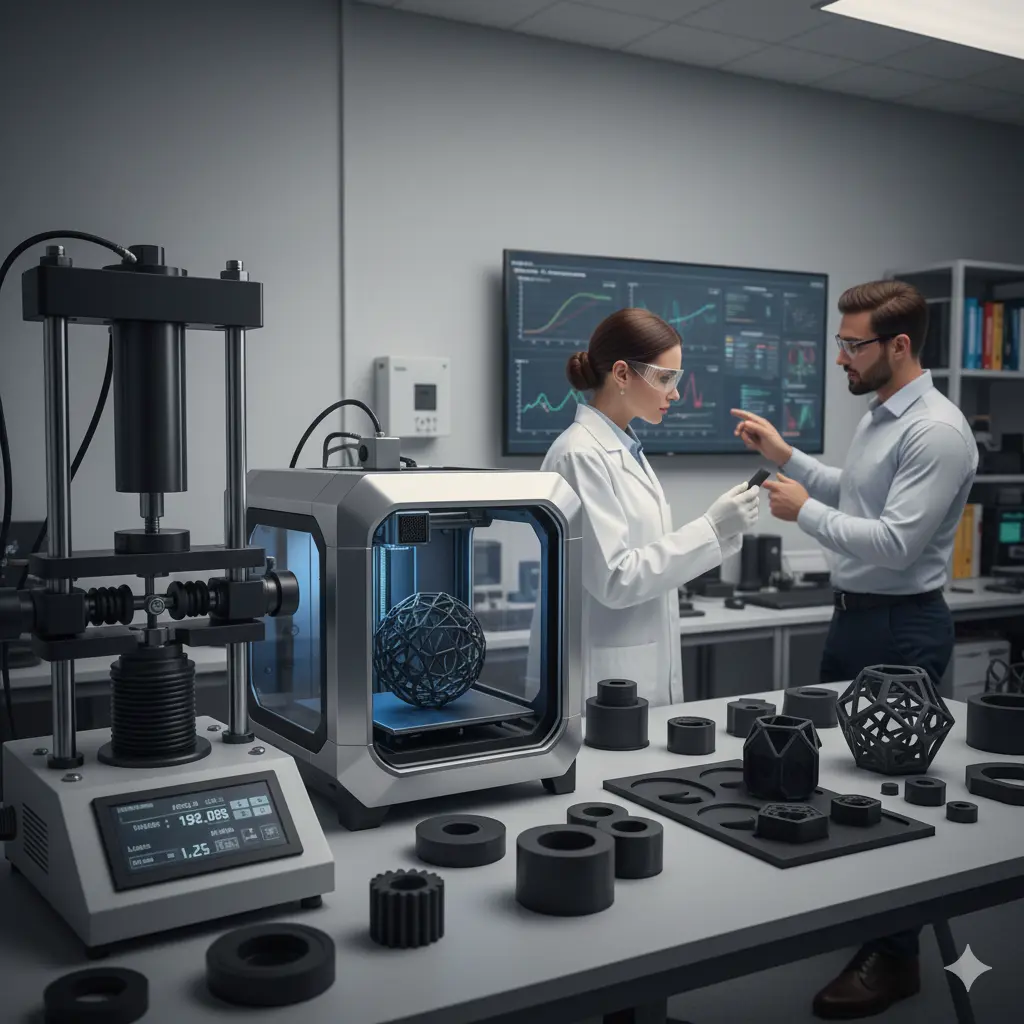
A Material's Lifecycle
When a rubber component is designed (whether it's a car tire, a medical seal, or a part of a robot) its immediate strength reflects only part of its performance. What also matters is how it performs over thousands or millions of cycles of use. This is where fatigue testing becomes essential. Unlike a single tensile test that pulls a material to its breaking point, fatigue testing reveals a material's long-term performance and resistance to repeated stress. This article is a research summary for materials engineers and lab managers on why fatigue testing is critical for rubber compounds, and how it applies to both traditional and 3D printed materials.
1. What is Fatigue Testing?
Fatigue testing is a method for assessing how a material responds to cyclical loading (repeatedly being stretched, bent, or compressed). It simulates the real-world conditions a product will face over its service life. The goal is to determine the point at which a material fails, not from a single, high-force event, but from the accumulation of micro-damage over time.
This process differs fundamentally from a single tensile test (like those performed under ASTM D412/ISO 37 standards [1, 13]). A tensile test measures a material's ultimate strength and elongation at one specific point in time. Fatigue testing, on the other hand, provides a measure of durability testing and material lifetime, which are often more relevant metrics for many applications [2].
2. Why Fatigue Testing is Important for Rubber Compounds
Rubber is unique because of its high elasticity and ability to return to its original shape. However, this elasticity is not infinite. Repeated deformation can cause molecular chains to break down, leading to a gradual loss of mechanical properties [21, 22]. Without fatigue testing, a rubber part might pass all initial quality control tests and still fail prematurely in the field. This makes it a crucial part of product development and quality assurance, ensuring components can meet their designed long-term performance goals [23, 24].
3. How Fatigue Testing Differs for Traditional vs. 3D Printed Rubbers
The principles of fatigue apply to all rubber compounds, but the results can vary significantly between traditional and 3D printed rubbers [24].
- Traditional Rubbers (Moulded/Machined): These materials are typically homogeneous, meaning their properties are uniform throughout the part. When a moulded rubber compound undergoes fatigue, the failure is often predictable and based on the material's inherent properties and curing process. Materials engineers can rely on well-established data to predict material lifetime.
- 3D Printed Rubbers (e.g., TPU): 3D printed rubbers, like those made from flexible TPU filament, are not homogeneous. The additive manufacturing process creates layers, which introduce anisotropy (direction-dependent properties) and potential weaknesses at the bond lines between layers [42, 43]. This can make the printed parts weak in loadings perpendicular to the build orientation [43]. This means that a 3D printed rubber part's durability testing results can vary greatly depending on the print orientation and infill pattern [42, 43]. Fatigue failure in these parts often occurs at the layer interfaces, a failure mode that is unique to the additive manufacturing process [43].
4. ISO and ASTM Standards for Rubber Fatigue Testing
Understanding and adhering to standardized test methods is essential for obtaining reliable, reproducible fatigue testing results. Several key international standards govern fatigue testing of rubber materials:
Primary ASTM Standards
ASTM D430 - Standard Test Methods for Rubber Deterioration - Dynamic Fatigue This is the foundational standard for estimating the ability of soft rubber materials to resist dynamic fatigue [2]. The test methods cover procedures for repeated flexing that estimate fatigue resistance, though they explicitly note that no exact correlation between test results and service conditions is given or implied due to the varied nature of real-world applications. The standard yields comparative data useful for evaluating rubber or composite rubber-fabric materials [33, 34].
ASTM D813 - Standard Test Method for Rubber Deterioration - Crack Growth This method focuses specifically on crack propagation in rubber materials [4]. A rubber sample is pierced, clamped into a flexing machine, and subjected to prescribed flexing cycles. The growth of the initial flaw is then measured over time to understand how cracks develop under cyclic loading. This test is particularly valuable for synthetic rubber materials [33, 34].
ASTM D4482 - Standard Test Method for Rubber Property - Extension Cycling Fatigue Unlike other flex fatigue tests that involve pre-cut samples, ASTM D4482 evaluates extension cycling fatigue on whole, uncut samples [5]. Specimens undergo repeated elongation and relaxation cycles to predict when cracks or imperfections may appear during service. This method is commonly used in the tire industry to assess fatigue life under tensile strain cycles [33, 34].
ASTM D623 - Standard Test Methods for Rubber Property - Heat Generation and Flexing Fatigue in Compression This standard addresses the critical issue of heat build-up during cyclic compression, which is particularly relevant for applications where rubber components experience repeated compressive loads (such as engine mounts and vibration isolators) [3, 32].
Key ISO Standards
ISO 6943 - Rubber, Vulcanized - Determination of Tension Fatigue This international standard provides methods for determining the resistance of vulcanized rubbers to fatigue under repeated tensile deformation [17]. The test is designed so that there is minimal temperature rise during cycling, ensuring that failure results from crack growth rather than thermal degradation. This is considered one of the most flexible standard methods for generating fatigue life curves (strain versus number of cycles to failure) [34].
ISO 37 - Rubber, Vulcanized or Thermoplastic - Determination of Tensile Stress-Strain Properties While primarily a tensile testing standard, ISO 37 serves as a baseline for understanding the static mechanical properties that are then compared with dynamic fatigue performance [13].
Environmental and Condition Testing Standards
When assessing fatigue performance, it's crucial to consider environmental factors that affect rubber degradation:
- Temperature effects: Testing at elevated temperatures helps simulate accelerated aging and real-world thermal conditions [25, 32]
- Chemical exposure: Standards for testing rubber resistance to oils, fuels, and other chemicals (ISO 1817 [16], ASTM D471 [7]) complement fatigue testing [31]
- Ozone resistance: ASTM D1149 [8] and ISO 1431 [15] evaluate crack formation due to ozone exposure
- Compression set: ASTM D395 [6] and ISO 815 [14] measure the permanent deformation after compression, which relates to long-term durability
It's important to note that these standards emphasize that laboratory test results provide comparative data for material selection and quality control, but should be validated against actual service conditions whenever possible [2, 17].
5. Industry Lifecycle Testing Examples
Understanding how fatigue testing translates to real-world applications provides valuable context for materials engineers. Here are three key industry examples of lifecycle fatigue testing:
Example 1: Automotive Tire Fatigue and Durability
Application Context Automotive tires represent one of the most demanding applications for rubber fatigue testing. A tire endures millions of deformation cycles throughout its service life while being exposed to varying temperatures, road conditions, and loading scenarios [24, 35].
Testing Approach The tire industry employs comprehensive fatigue testing programs that include both laboratory and field testing. According to research by the National Highway Traffic Safety Administration (NHTSA), tire aging involves two primary degradation mechanisms: thermo-oxidative aging (degradation of rubber compounds due to heat and oxygen) and cyclic fatigue during tire deformation [26]. The most critical region assessed is the belt-edge area in the tire shoulder, where mechano-thermo-oxidative degradation is most severe [26].
Laboratory testing includes:
- Dynamic fatigue testing on indoor roadwheel systems at 1.707m diameter [26]
- Micro-DeMattia flex fatigue testing for skim-coat and wedge compounds [26]
- Heat build-up measurements under both strain-controlled (sidewall) and stress-controlled (tread center) conditions [32]
- Accelerated aging protocols that simulate years of environmental exposure [26]
Modern tire testing facilities use advanced equipment like the Metravib DMA+2000, which can evaluate heat generation inside tire materials under both strain-controlled and stress-controlled conditions simultaneously while measuring viscoelastic properties [32]. This allows engineers to assess material performance in different tire regions (sidewall vs. tread) where different loading conditions dominate.
Key Metrics and Standards
- Cycles to crack initiation and propagation
- Heat build-up characteristics [32]
- Crosslink density changes over time [26]
- Tensile strength and elongation degradation [26]
- Testing per ASTM D430 [2], D4482 [5], and proprietary manufacturer protocols [33]
(a)

(b)
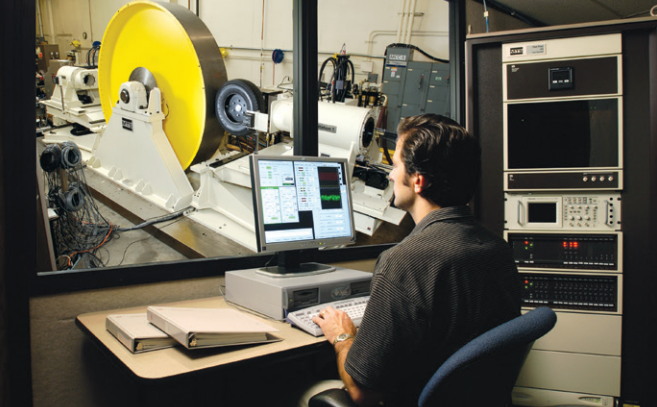
Figure X: (a) examples of tire deformation [44] and (b) tire fatigue testing on an indoor roadwheel system [45]
Example 2: Medical Device Seals and Packaging Integrity
Application Context Medical device packaging requires sterile seals that maintain integrity throughout the product's shelf life—often several years. These seals must withstand sterilization processes, transportation vibrations, and storage conditions while remaining easy enough for healthcare professionals to open aseptically [36, 38].
The lifecycle approach requires testing at multiple stages: immediately after sealing, after sterilization, after accelerated aging, and at various intervals throughout the product's shelf life [38, 39]. Seal failure modes are carefully analyzed, adhesive failure (at the interface), cohesive failure (within the sealant), or material failure (tearing of packaging), to understand and improve seal durability [37].
Key Metrics and Standards
- Peel strength uniformity and consistency [36, 37]
- Seal integrity after aging and environmental exposure [38, 39]
- Microbial barrier effectiveness over time [39]
- Standards: ISO 11607-1 & 11607-2 [18, 19], ASTM F88 [9], ASTM F1980 [11], ASTM F2096 [12]

Figure X: Laboratory peel test setup showing a medical device package being tested for seal strength [39].
Example 3: Aerospace and Defense Vibration Isolators
Application Context Rubber vibration isolators in aerospace applications must reliably dampen vibrations and shocks over decades of service while exposed to extreme temperatures, chemicals (fuels, hydraulic fluids), and high-frequency cyclic loading [28, 29, 30]. These components are critical for protecting sensitive avionics, instruments, and structural components from fatigue damage [40, 41].
Testing Approach Aerospace-grade rubber isolators undergo extensive qualification testing that combines environmental exposure with mechanical fatigue [30, 31]:
- Dynamic characterization measuring stiffness and damping at frequencies from static conditions up to 300 Hz [30, 40]
- Multi-axis fatigue testing simulating combined radial, axial, and torsional loads using servohydraulic test systems [40]
- Temperature cycling combined with mechanical loading to assess performance across the operational temperature range (-55°C to +125°C or wider) [31]
- Chemical resistance testing with exposure to aviation fuels, lubricants, and hydraulic fluids followed by mechanical property verification [31]
- Long-term durability testing extending to 100 million cycles for laminated rubber-metal structures [30]
Research on aerospace laminated rubber bearings shows these heavy-duty composites can achieve exceptionally high fatigue life when properly designed [29, 30]. Testing typically involves accelerated lifetime experiments under random vibration loading, with structural parameters varied to model degradation and predict service life [30].
The testing philosophy differs from consumer products: aerospace applications often require "fatigue-to-fracture" testing that pushes components beyond their design limits to establish safety margins and understand failure mechanisms.
Key Metrics and Standards
- Dynamic stiffness as a function of frequency and temperature [30, 40]
- Damping coefficient and loss factor [30, 40]
- Fatigue life under multiaxial loading [30, 31]
- Performance degradation due to environmental exposure [31]
- Relevant standards include proprietary aerospace specifications, ISO/IEC 17025 [20] for test lab accreditation, and ASTM standards adapted for aerospace requirements
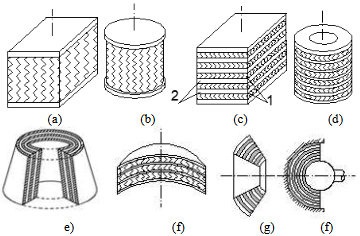
Fig. X. Construction of typical elastomeric shock absorbers: (a) rectangular prism, (b)straight circular cylinder; blocks of thin-layer rubber-metal elements: (c) –rectangular, (d) –cylindrical form, (e) –conical form, (f) –spherical pad, (g) –spherical nozzle, (f) spherical hinge; 1 –rubber layer, 2 –metal layer [30]
(d)
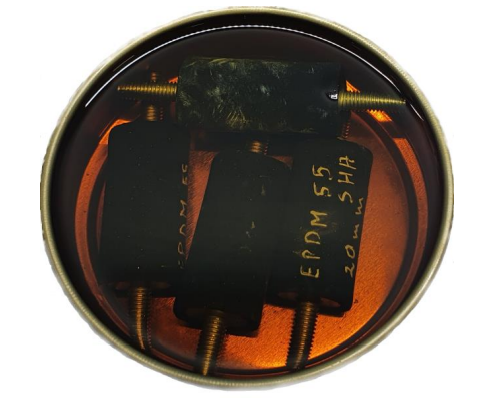
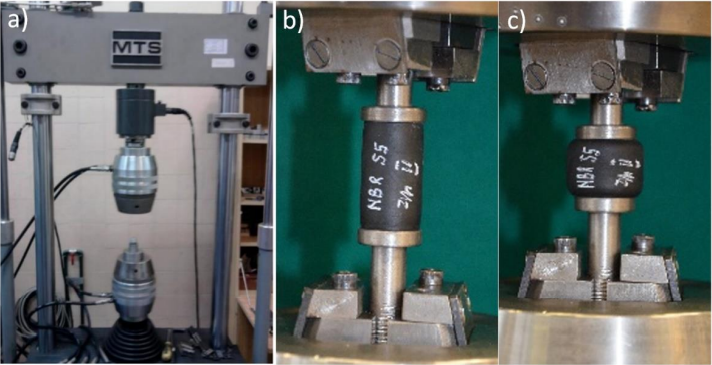
Figure X: From the left: (a) view of MTS tensile machine, (b) absorber during the initial phase tests, (c) absorber under static compression of 20 mm, and (d) an example of vibration isolators during ageing in fuel and oil mixture.
Conclusion
Fatigue testing is an indispensable tool for materials engineers working with rubber compounds. By understanding the relevant standards (ASTM D430 [2], D813 [4], D4482 [5], ISO 6943 [17]) and learning from industry applications in automotive [26, 32, 33], medical [18, 19, 36-39], and aerospace [28-31, 40,41] sectors, engineers can better predict long-term performance and prevent premature failures. Whether working with traditional molded rubbers or emerging 3D printed elastomers, a comprehensive approach to fatigue testing, combined with environmental condition testing [6-8, 14-16, 25, 31], ensures that rubber components will perform reliably throughout their intended service life [21-24, 27].
The examples from tire testing, medical device packaging, and aerospace vibration isolation demonstrate that while the fundamental principles of fatigue testing remain constant [2, 17], each application requires tailored testing protocols that reflect real-world loading conditions, environmental exposures, and performance requirements [26, 38].
References
Standards
- ASTM D412-16. Standard Test Methods for Vulcanized Rubber and Thermoplastic Elastomers—Tension. ASTM International, West Conshohocken, PA. https://store.astm.org/d0412-16.html
- ASTM D430-06(2018). Standard Test Methods for Rubber Deterioration—Dynamic Fatigue. ASTM International, West Conshohocken, PA. https://store.astm.org/d0430-06r18.html
- ASTM D623-19. Standard Test Methods for Rubber Property—Heat Generation and Flexing Fatigue in Compression. ASTM International, West Conshohocken, PA. https://store.astm.org/d0623-07r19e01.html
- ASTM D813-07(2018). Standard Test Method for Rubber Deterioration—Crack Growth. ASTM International, West Conshohocken, PA. https://store.astm.org/d0813-07r19.html
- ASTM D4482-11(2021). Standard Test Method for Rubber Property—Extension Cycling Fatigue. ASTM International, West Conshohocken, PA. https://store.astm.org/d4482-11r21.html
- ASTM D395-18. Standard Test Methods for Rubber Property—Compression Set. ASTM International, West Conshohocken, PA. https://store.astm.org/d0395-18.html
- ASTM D471-16a. Standard Test Method for Rubber Property—Effect of Liquids. ASTM International, West Conshohocken, PA. https://store.astm.org/d0471-16a.html
- ASTM D1149-16. Standard Test Method for Rubber Deterioration—Cracking in an Ozone Controlled Environment. ASTM International, West Conshohocken, PA. https://store.astm.org/d1149-16.html
- ASTM F88/F88M-21. Standard Test Method for Seal Strength of Flexible Barrier Materials. ASTM International, West Conshohocken, PA. https://store.astm.org/f0088_f0088m-21.html
- ASTM F1929-15. Standard Test Method for Detecting Seal Leaks in Porous Medical Packaging by Dye Penetration. ASTM International, West Conshohocken, PA. https://store.astm.org/f1929-15.html
- ASTM F1980-16. Standard Guide for Accelerated Aging of Sterile Barrier Systems for Medical Devices. ASTM International, West Conshohocken, PA. https://store.astm.org/f1980-16.html
- ASTM F2096-19. Standard Test Method for Detecting Gross Leaks in Packaging by Internal Pressurization (Bubble Test). ASTM International, West Conshohocken, PA. https://store.astm.org/f2096-11r19.html
- ISO 37:2024. Rubber, vulcanized or thermoplastic—Determination of tensile stress-strain properties. International Organization for Standardization, Geneva, Switzerland. https://www.iso.org/standard/86892.html
- ISO 815-1:2019. Rubber, vulcanized or thermoplastic—Determination of compression set—Part 1: At ambient or elevated temperatures. International Organization for Standardization, Geneva, Switzerland. https://www.iso.org/standard/74943.html
- ISO 1431-1:2024. Rubber, vulcanized or thermoplastic—Resistance to ozone cracking—Part 1: Static and dynamic strain testing. International Organization for Standardization, Geneva, Switzerland. https://www.iso.org/standard/86601.html
- ISO 1817:2024. Rubber, vulcanized or thermoplastic—Determination of the effect of liquids. International Organization for Standardization, Geneva, Switzerland. https://www.iso.org/standard/86602.html
- ISO 6943:2017. Rubber, vulcanized—Determination of tension fatigue. International Organization for Standardization, Geneva, Switzerland. https://www.iso.org/standard/72790.html
- ISO 11607-1:2019. Packaging for terminally sterilized medical devices—Part 1: Requirements for materials, sterile barrier systems and packaging systems. International Organization for Standardization, Geneva, Switzerland. https://www.iso.org/standard/70799.html
- ISO 11607-2:2019. Packaging for terminally sterilized medical devices—Part 2: Validation requirements for forming, sealing and assembly processes. International Organization for Standardization, Geneva, Switzerland. https://www.iso.org/standard/70800.html
- ISO/IEC 17025:2017. General requirements for the competence of testing and calibration laboratories. International Organization for Standardization, Geneva, Switzerland. https://www.iso.org/standard/66912.html
Research Articles and Technical Papers
- Mars, W.V., and Fatemi, A. (2002). "A Literature Survey on Fatigue Analysis Approaches for Rubber." International Journal of Fatigue, 24(9), pp. 949-961. https://doi.org/10.1016/S0142-1123(02)00008-7
- Mars, W.V., and Fatemi, A. (2004). "Factors that Affect the Fatigue Life of Rubber: A Literature Survey." Rubber Chemistry and Technology, 77(3), pp. 391-412. https://doi.org/10.5254/1.3547831
- Tee, Y.L., Loo, M.S., and Andriyana, A. (2018). "Recent Advances on Fatigue of Rubber after the Literature Survey by Mars and Fatemi in 2002 and 2004." International Journal of Fatigue, 110, pp. 115-129. https://doi.org/10.1016/j.ijfatigue.2018.01.007
- Li, F., Liu, J., Mars, W.V., Chan, T.W., Lu, Y., Yang, H., and Zhang, L. (2025). "Rubber Fatigue Revisited: A State-of-the-Art Review Expanding on Prior Works by Tee, Mars and Fatemi." Polymers, 17(7), 918. https://doi.org/10.3390/polym17070918
- Luo, R., Wu, J., Mortel, W.J., and Liu, X. (2019). "Strain Energy-Based Rubber Fatigue Life Prediction Under the Influence of Temperature." Royal Society Open Science, 6(8), 180951. https://doi.org/10.1098/rsos.180951
- National Highway Traffic Safety Administration (NHTSA). (2014). NHTSA Tire Aging Test Development Project - Phase 2 Evaluation: Laboratory Aging of Tires. Report No. DOT HS 811 885, U.S. Department of Transportation, Washington, DC. Available at: https://www.nhtsa.gov/sites/nhtsa.gov/files/811885_tireagingtestdevelopmentprojectphase2evallab.pdf
- Bauman, J.T. (2008). Fatigue, Stress and Strain of Rubber Components: Guide for Design Engineers. Carl Hanser Verlag, Munich, Germany.
- Kelly, J.M., and Konstantinidis, D.A. (2011). Mechanics of Rubber Bearings for Seismic and Vibration Isolation. John Wiley & Sons, Chichester, UK.
- Hinks, W.L. (2013). "Laminated-Rubber Bearings: Heavy Duty Composites for Aerospace and Undersea." Presentation at the Spring 2013 183rd Technical Meeting of the Rubber Division of the American Chemical Society, Randolph Research Co. https://www.slideshare.net/slideshow/presentation-rubber-div/18856094#24
- Kravchenko, O.G., Kravchenko, S.G., and Sun, C.T. (2017). "Aging, Fatigue and Durability of Rubber Vibration Isolation Elements." Environment. Technologies. Resources. Proceedings of the International Scientific and Practical Conference, 1, pp. 137-142. https://doi.org/10.17770/etr2017vol3.2664
- Dębski, M., Mądry, A., and Ostrowski, P. (2022). "The Fatigue Wear Process of Rubber-Metal Shock Absorbers." Materials, 15(6), 2110. https://doi.org/10.3390/polym14061186
Industry and Technical Resources
- Shahrostambeik, A. (2025). "Heat Build-Up Fatigue in Rubber Materials." Technical Blog. https://ctherm.com/resources/newsroom/blog/heat-build-up-fatigue/
- ACE Laboratories. (2025). "Rubber Fatigue Testing - Purpose & Test Types." Technical Resources. https://www.ace-laboratories.com/rubber-fatigue-testing/
- AdvanSES Laboratory. (2025). "Fatigue Testing of Rubber Materials: ASTM D430, ASTM D813 and ASTM D4482." Technical Resources. https://advanses.com/fatigue-testing-of-rubber-materials/
- NextGen Material Testing. (2025). "The Importance of Rubber Material Testing in Product Durability." Technical Blog. https://www.nextgentest.com/blog/the-importance-of-rubber-material-testing-in-product-durability/
- Packaging Compliance Labs (PCL). (2020). "Seal Strength Testing." Technical Resources. Available at: https://pkgcompliance.com/seal-strength-testing/
- FlexPak Inc. (2024). "Seal Strength Test Methods: Ensuring Package Integrity and Safety." Technical Resources. Available at: https://flexpakinc.com/seal-strength-test-method/
- Vantage Medtech. (2025). "What Goes Into Medical Device Package Integrity Testing?" Technical Resources. Available at: https://vantagemedtech.com/medical-device-package-integrity-testing/
- ProTech Design. (2024). "Understanding the Basics of Medical Device Packaging Testing." Technical Resources. Available at: https://protechdesign.com/articles/understanding-the-basics-of-medical-device-packaging-testing/
- Greene Rubber Company. (2023). " Shock and Vibration Isolation Products" Product Catalog and Technical Resources. Available at: https://www.greenerubber.com/shock-and-vibration/
- Enterprise Rubber. (2024). "Understanding Vibration Isolation Applications." Technical Resources. Available at: https://enterpriserubber.com/blogs/news/vibration-isolation-applications
- Strelkova, D., and Urbanic, R.J. (2025). "Brittle or Ductile? Effects of Print Orientation and Raster Angle on Polylactic Acid (PLA) Fused Filament Fabrication (FFF) Tensile Samples." SAE Technical Paper 2025-01-8335. https://doi.org/10.4271/2025-01-8335
- Osswald, P.V., Obst, P., Mazzei, D., Maldonado, A., and Riess, G. (2021). "Material Anisotropy in Additively Manufactured Polymers and Polymer Composites: A Review." Polymers, 13(19), 3368. https://doi.org/10.3390/polym13193368
- https://journals.sagepub.com/doi/10.1177/09544070241231031
- https://www.mts.com/-/media/ground_vehicles/pdfs/brochures/100-153-053c_TireTreadWear.pdf?as=1
- https://www.mdpi.com/2075-5309/2/3/300
Related Articles
More expert insights and practical solutions to advance your material testing expertise.
Automated Rubber Tensile Testing Machines: A Guide for High-Volume Testing Labs
Universal Testing Machine: Complete Guide to Specifications, Applications & Automation
Tensile Strength Tester: A Buyer's Guide for QA Labs
Tensile Test of Composite Materials: A Practical Guide

Universal Testing Machine for Rubber: 2026 Buyer Guide
ASTM D3039: How to Test Composite Tensile Properties
Robotic Material Testing: The Complete Guide to Automating Your Lab

Automated Tensile Testing: How Labs Cut Cycle Time Up to 85%
Composite Material Testing: Methods, Standards, and Automation
Tensile Testing Machine Guide for Plastics & Rubber Labs

Polymer Tensile Test: Procedure, Standards & Automation
Polymer Mechanical Testing: Methods, Standards & Automation
Lab Automation Robotics for Plastics and Rubber QA Teams
How to Choose Plastics Tensile Testing Equipment
ASTM D638 Automated Testing: Run 3× More Specimens Per Day
Materials Testing Automation: How Plastics and Rubber Labs Run 3× More Tests Per Shift
ASTM D790/ISO 178 Explained: Everything You Need to Know About Plastic Flexural Testing
How Temperature and Humidity Affects Tensile Strength in Plastics