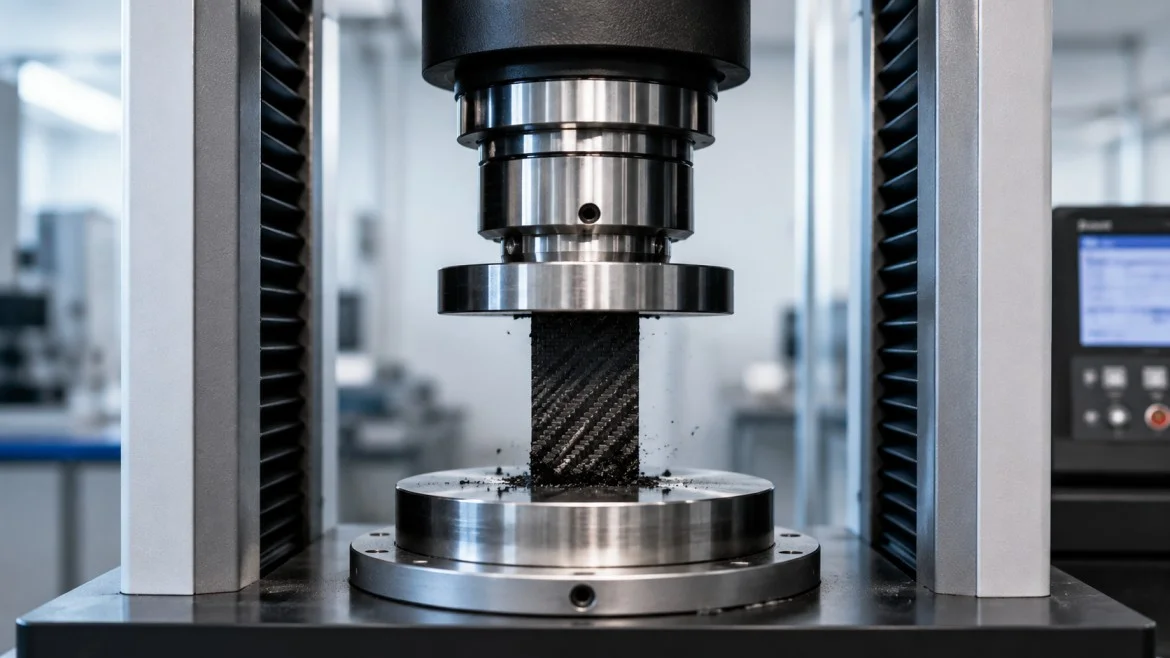
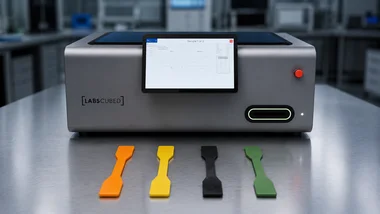
ASTM D3039/D3039M is the standard test method for the in-plane tensile properties of polymer matrix composite materials reinforced by high-modulus fibers — carbon, fiberglass, and aramid laminates. It defines specimen geometry, conditioning, grip alignment, strain measurement, and reporting so that ultimate tensile strength, modulus, and Poisson's ratio can be compared across labs. The current revision is D3039/D3039M-17(2025), maintained by ASTM Committee D30 on Composite Materials. At LabsCubed we run D3039 on automated platforms — CubeTen and CubeOne — because composites magnify every manual mistake, and operator-to-operator variability is typically where most reported scatter comes from. In this guide you'll learn what ASTM D3039 measures, how specimen and grip choices change the result, the most common mistakes that flag a retest, and how automating the workflow reduces variability across operators and shifts.
What is ASTM D3039?
ASTM D3039 is the standard test method for measuring the in-plane tensile properties of polymer matrix composites reinforced by continuous, high-modulus fibers. It applies to flat, balanced, symmetric laminates loaded in uniaxial tension and reports ultimate tensile strength, tensile modulus of elasticity, tensile strain at failure, and (when transverse strain is measured) Poisson's ratio.
What does ASTM D3039 measure?
The test produces four core values: ultimate tensile strength (Ftu), Young's modulus (E), tensile strain at failure (εtu), and — when a biaxial extensometer or strain rosette is used — Poisson's ratio (ν). It also requires a documented failure mode code (e.g., LAT, LGM, AGM) so engineers can confirm the failure occurred within the gauge length and not at the grips.
Which composites does ASTM D3039 cover?
D3039 covers polymer matrix composites with high-modulus reinforcement: carbon/epoxy, glass/epoxy, aramid/epoxy, and similar laminates used in aerospace, wind energy, automotive, and pressure-vessel applications. The standard works for unidirectional [0°]n, transverse [90°]n, balanced symmetric, and quasi-isotropic layups. Discontinuous-fiber composites typically fall under our broader composite material testing guide rather than D3039 specifically.
What is the difference between ASTM D3039 and ASTM D3039M?
The D3039 designation uses inch-pound units; D3039M uses SI metric units. The test method itself is identical — same specimen, same grips, same loading rate, same calculations — only the reported units differ. ASTM publishes the standard as a combined document (D3039/D3039M) and most labs cite both designations together on the test report.
What specimens does ASTM D3039 require?
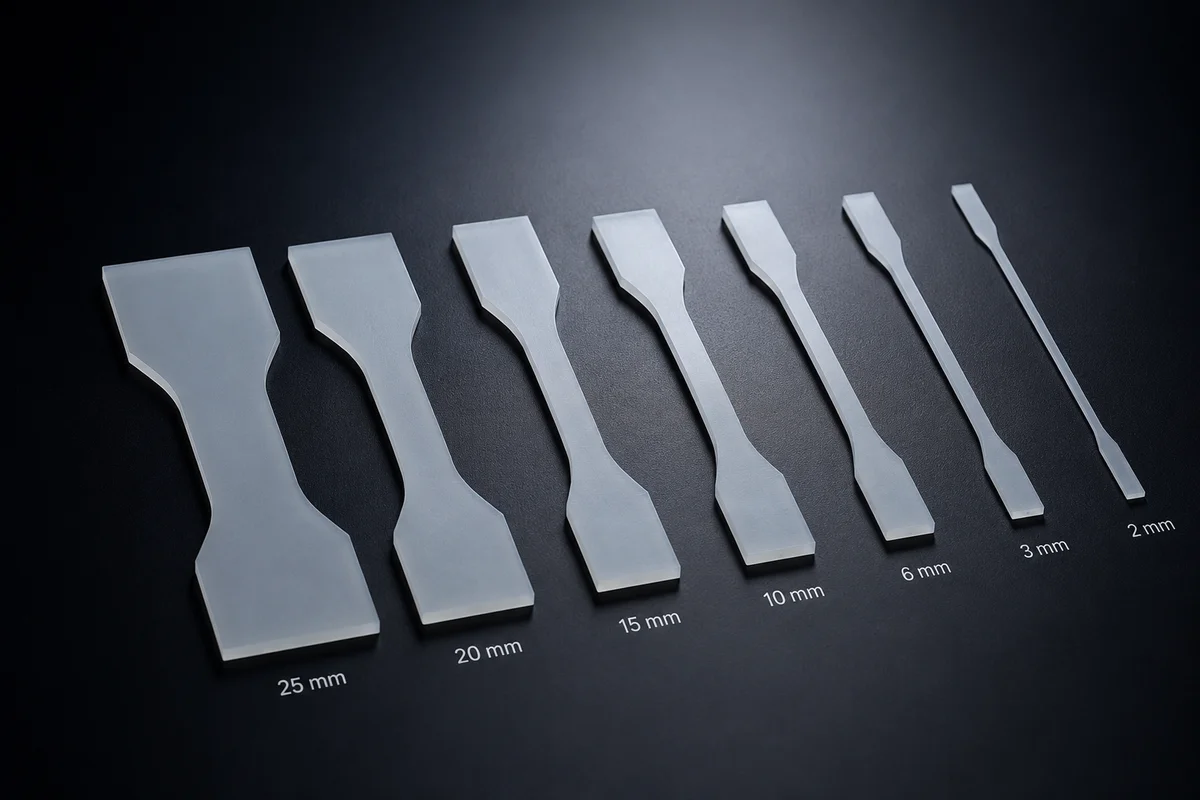
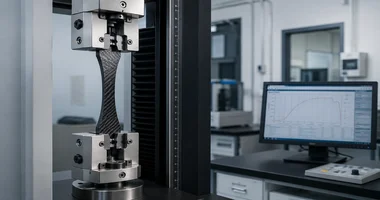
D3039 specifies rectangular straight-sided coupons cut from the laminate. The standard does not mandate a single geometry; instead it provides recommended dimensions per fiber orientation, and the operator selects a width, thickness, and gauge length that produces a valid gauge-section failure. Specimen tabs may or may not be required depending on grip type and material strength.
What are the standard specimen sizes for ASTM D3039?
Typical recommended geometries follow the laminate orientation:
Recommended ASTM D3039 specimen geometries
Laminate
Length
Width
Thickness
Tabs
0° unidirectional
250 mm
15 mm
1.0 mm
Required
90° unidirectional
175 mm
25 mm
2.0 mm
Required
Balanced and symmetric
250 mm
25 mm
2.5 mm
Optional
Length includes the tabbed region. The standard requires a minimum gauge length capable of accommodating the extensometer plus a uniform stress field — usually 100–150 mm.
When do you need specimen tabs?
Tabs distribute the grip load into the laminate so failure occurs in the gauge section, not at the grips. They are required for 0° unidirectional specimens (because raw fiber strength would otherwise crush at the grip face) and strongly recommended for high-strength balanced laminates. Tabs are typically 1–2 mm thick glass/epoxy or aluminum, bonded with film adhesive, with a tab bevel of 5°–90°. A grip slip or grip-induced failure (LAT or LIT codes) invalidates the result.
Specimen measurement and conditioning
Each specimen is measured at three locations along the gauge length with calipers or a micrometer, and the minimum cross-section is used for stress calculations. Per Section 10, specimens are conditioned at 23 °C and 50% relative humidity for at least 40 hours before testing, unless an alternative environment is specified. Skipping conditioning is one of the most common reasons aerospace QA flags a retest.
How do you run an ASTM D3039 test?
A D3039 test loads a tabbed coupon in tension at a constant head speed (typically 2 mm/min) until failure, with continuous load and strain measurement. The lab records ultimate load, stress at failure, modulus from the linear region (between 1,000 and 3,000 µε per Section 13), and the failure mode code. A valid test requires gauge-section failure, recorded environment, and traceable specimen dimensions.
Grip selection and alignment
D3039 calls for wedge or hydraulic grips that apply lateral pressure to the tabs without crushing the laminate. Grip alignment is critical: misalignment of more than ~0.5° introduces bending stress that lowers measured strength by 5–15%. The standard recommends checking alignment with a strain-gauged alignment specimen per ASTM E1012. Most reported lab-to-lab variability on D3039 traces back to this single source.
Loading rate and strain measurement
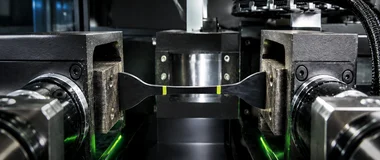
Standard head displacement is 2 mm/min, producing a typical time-to-failure of 1–10 minutes. Strain is measured with either a clip-on or non-contacting extensometer over a 25–50 mm gauge length. For modulus, the chord between 1,000 µε and 3,000 µε is used. Bonded strain gauges are acceptable but typically reserved for Poisson's ratio measurement using a biaxial rosette.
Reporting required by D3039
Section 14 specifies the minimum report: material identification, laminate stacking sequence, specimen dimensions (mean and standard deviation), conditioning environment, test temperature and humidity, loading rate, strength and modulus for each specimen plus the mean, standard deviation, and coefficient of variation, and the failure mode code with location. Audit-trail systems should also capture grip torque, alignment check date, and extensometer calibration ID.
How does manual testing compare to automated ASTM D3039?
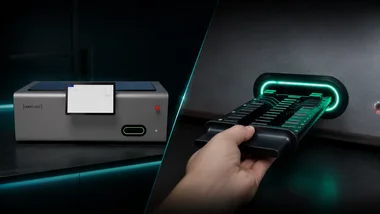
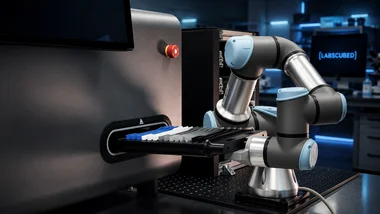
Manual D3039 testing relies on operator judgment for specimen loading, grip torque, and alignment check — all of which drive lab-to-lab scatter. Automated platforms like CubeTen and CubeOne apply identical grip pressure, identical loading rate, and identical specimen alignment every cycle, which typically reduces coefficient of variation across operators and shifts. The trade-off is upfront integration time; the payoff is repeatability under audit.
Workflow step
Manual D3039
Recommended CubeOne / CubeTen
Specimen loading
Operator-handled; alignment varies between technicians
Robotic pick-and-place from tray; alignment is deterministic
Grip torque
Hand-torqued or pneumatic; varies by operator
Servo-controlled to a fixed setpoint, logged per specimen
Alignment check
Performed monthly or quarterly; rarely between operators
Verified against a strain-gauged reference at each shift change
Conditioning audit
Recorded on paper or spreadsheet
Pulled from environmental log automatically and tied to the specimen ID
Throughput
Typically 20–40 specimens per day depending on tabbing and conditioning
Up to 3× the manual throughput on a single CubeTen under continuous operation
Coefficient of variation (typical)
4–8% on strength, depending on operator
Typically 2–4%, depending on layup and conditioning consistency
Audit trail
Manual transcription of load, strain, failure code
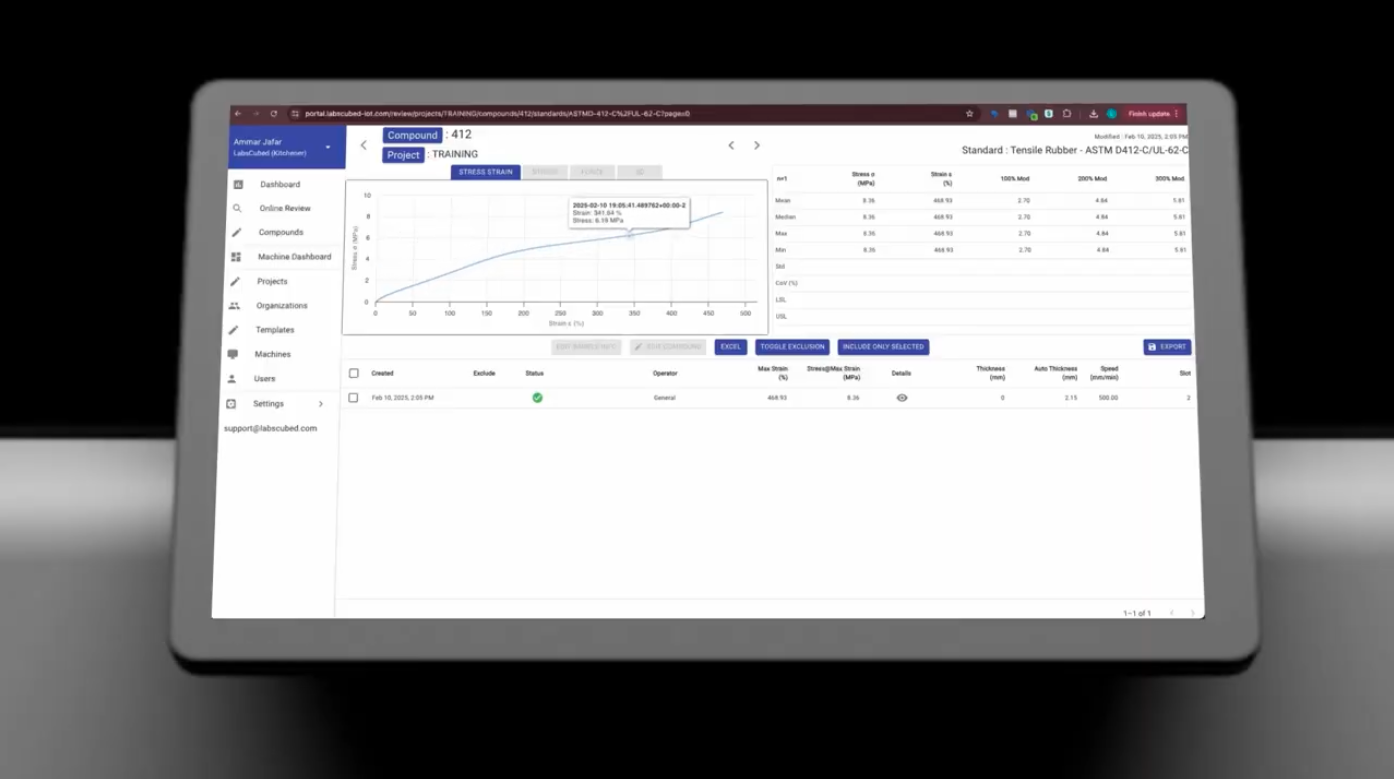
Specimen ID → raw load/strain trace → failure photo → report, automatically
The systems-level point: automation does not just save time on D3039. It removes the operator-to-operator delta that aerospace QA, wind blade certification, and pressure-vessel acceptance flag during round-robin studies. For a deeper treatment, see our manual vs. automated testing white paper.
What is the current version of ASTM D3039?
The current revision is ASTM D3039/D3039M-17, reapproved in 2025 (cited as D3039/D3039M-17(2025)). It is published by ASTM Committee D30 on Composite Materials, Subcommittee D30.04 on Lamina and Laminate Test Methods. The 2025 reapproval did not change the test method itself; it confirmed the 2017 revision is still current technical practice.
D3039 revision history
The standard was first published as D3039-71. Major revisions include D3039-76 (added the M designation for metric units), D3039-93 (introduced specimen recommendations by fiber orientation), D3039-00 (modernized failure mode codes), D3039-08 (clarified modulus chord), and D3039-14 / -17 (further alignment and reporting clarifications). The current document is one of the most-cited tensile standards in automated tensile testing programs.
Is there an ISO equivalent to ASTM D3039?
The closest ISO equivalent is ISO 527-4 and ISO 527-5, which cover tensile properties of isotropic/orthotropic fibre-reinforced plastic composites (Part 4) and unidirectional fibre-reinforced plastic composites (Part 5). The standards are similar in intent but differ in specimen dimensions, grip recommendations, and modulus chord. They are not interchangeable; aerospace QA programs that require D3039 typically do not accept ISO 527 data without a documented correlation study. The plastics equivalent for non-fiber-reinforced specimens is ASTM D638 / ISO 527 for plastics.
What are the most common mistakes in ASTM D3039 testing?
Most invalid D3039 results trace back to a small set of repeating mistakes — and almost all of them are easier to prevent than to detect after the fact. The list below is what we typically see during onboarding audits at customer labs.
Skipping the alignment check. Misalignment greater than ~0.5° introduces bending stress that lowers reported strength by 5–15%. Verify against a strain-gauged reference at each shift change, not quarterly.
Inconsistent grip torque. Hand-torqued grips vary between operators. Use a servo-controlled torque setpoint, log it per specimen, and fail the specimen out if it falls outside the band.
Missing or wrong tabs on 0° unidirectional coupons. Failure at the grip face (codes LAT or LIT) invalidates the result. Tab geometry and bond quality are not optional for unidirectional carbon.
Skipping conditioning. 40 hours at 23 °C / 50% RH is non-negotiable in aerospace QA. A conditioned vs. unconditioned coupon can differ by more than 10% in modulus for hygroscopic matrices.
Wrong modulus chord. Modulus is calculated between 1,000 and 3,000 µε. Using the full linear-elastic region or a fixed strain offset will produce a number that doesn't match the round-robin database.
Single-point caliper measurement. D3039 requires three measurements along the gauge length with the minimum used in the stress calculation. A tapered specimen with single-point measurement over-reports strength.
Untracked extensometer drift. A clip-on extensometer that slips during the test produces a falsely high modulus. Use redundant strain measurement on the first specimen of each layup batch.
No failure mode photo. Without a documented failure mode code and location, an aerospace QA reviewer cannot validate that the test is admissible. The mode goes in the report, not just on a sticky note on the sample.
How does LabsCubed automate ASTM D3039?
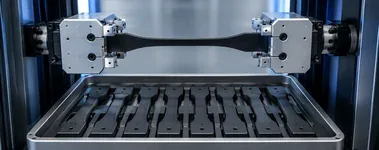
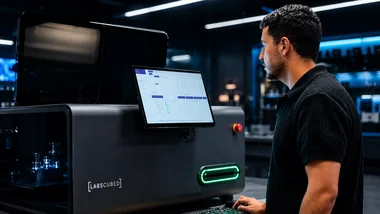
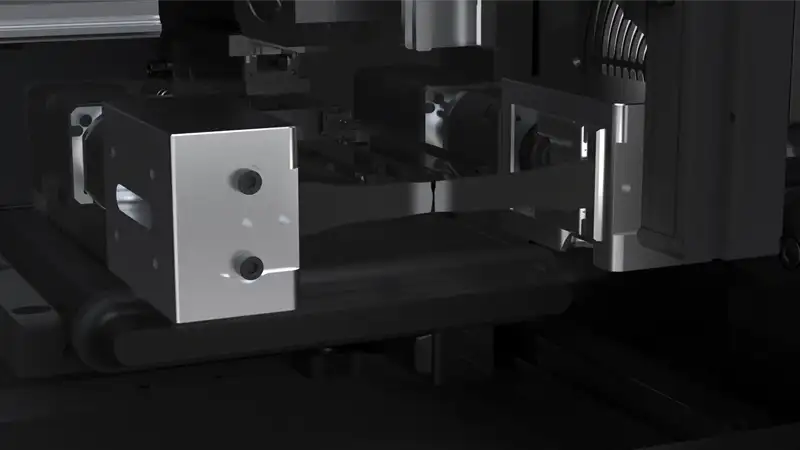
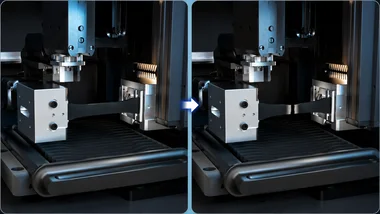
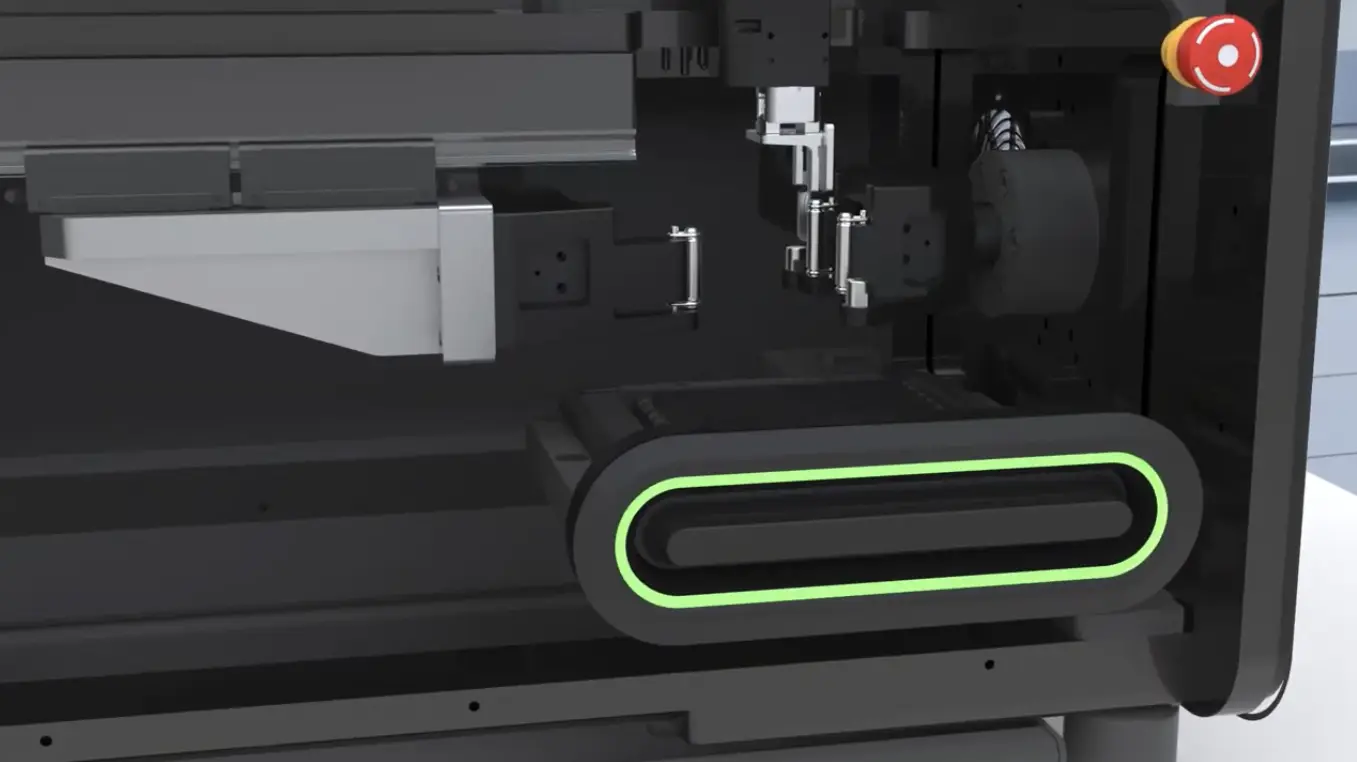
CubeTen and CubeOne run the full D3039 workflow end to end: specimens load from a robotic tray, grips close at a logged servo torque, the alignment check runs against an embedded strain-gauged reference at each shift, conditioning environment is pulled from the chamber log and tied to the specimen ID, the test executes at 2 mm/min, and the report — strength, modulus, strain at failure, failure code, raw load/strain trace, and failure photo — writes to the audit trail automatically. The operator's role shifts from running each test to validating the queue and reviewing flagged results.
The outcome we typically see during customer pilots: coefficient of variation falls from the 4–8% manual range to 2–4%, and throughput rises to up to 3× on a single CubeTen under continuous operation. The systems-level argument is not about replacing the technician — it is about removing the operator-to-operator delta that aerospace QA and wind blade certification round-robins flag. See our robotic material testing platform overview for the full hardware and software stack, or request a CubeTen demo to walk through D3039 on real coupons.
Frequently asked questions
What does ASTM D3039 measure in composites?
ASTM D3039 measures the in-plane tensile properties of polymer matrix composites reinforced by high-modulus fibers. It reports ultimate tensile strength, tensile modulus of elasticity, tensile strain at failure, and Poisson's ratio when transverse strain is measured. A valid test also reports the failure mode code and location per Section 14.
What specimen sizes does ASTM D3039 require?
D3039 provides recommended geometries by fiber orientation. Typical sizes are 250 × 15 × 1.0 mm for 0° unidirectional with tabs, 175 × 25 × 2.0 mm for 90° unidirectional with tabs, and 250 × 25 × 2.5 mm for balanced and symmetric laminates. The standard requires a uniform gauge section that accommodates the extensometer, typically 100–150 mm long.
What is the current version of ASTM D3039?
The current revision is D3039/D3039M-17, reapproved in 2025 and cited as D3039/D3039M-17(2025). The 2025 reapproval confirmed the 2017 technical practice without changing the test method. It is maintained by ASTM Committee D30 on Composite Materials, Subcommittee D30.04.
What is the difference between ASTM D3039 and D3039M?
D3039 uses inch-pound units; D3039M uses SI units. The specimen, grips, loading rate, and calculations are identical. ASTM publishes the document as a combined standard (D3039/D3039M), and most labs reference both designations together on the test report.
Is there an ISO equivalent to ASTM D3039?
The closest equivalents are ISO 527-4 (isotropic and orthotropic fibre-reinforced plastic composites) and ISO 527-5 (unidirectional fibre-reinforced plastic composites). They cover similar intent but differ in specimen dimensions, grip recommendations, and modulus chord. Aerospace QA programs that specify D3039 typically do not accept ISO 527 data without a documented correlation study.
Can ASTM D3039 testing be automated?
Yes. Automated systems like LabsCubed's CubeTen and CubeOne run D3039 end to end — robotic specimen loading, servo-controlled grip torque, per-shift alignment verification, environmental log integration, and automatic report generation. Customers typically see coefficient of variation drop from 4–8% to 2–4% and throughput rise up to 3× on a single platform under continuous operation.
Run D3039 with repeatability under audit
Explore how LabsCubed's CubeTen and CubeOne systems automate specimen handling, grip torque, alignment checks, and reporting to remove operator-to-operator variability from your composite tensile program.
The LabsCubed Team builds robotic, AI-driven systems for plastics, rubber, and composites QA labs. Our engineers have run D3039, D638, D412, and ISO 527 in production lab environments and during round-robin certifications. CubeOne and CubeTen are deployed in production labs across North America and Europe.
More expert insights and practical solutions to advance your material testing expertise.
Tensile Testing
Lab Automation
6 min read
Automated Rubber Tensile Testing Machines: A Guide for High-Volume Testing Labs
Learn how automated rubber tensile testing machines improve throughput, repeatability, and ASTM D412 compliance in modern testing laboratories.
Tensile Testing
Lab Automation
9 min
Universal Testing Machine: Complete Guide to Specifications, Applications & Automation
Learn how a universal testing machine works, what tests it performs, key specifications to evaluate, and how automation improves materials testing workflows.
Tensile Testing
Lab Automation
9 min
Tensile Strength Tester: A Buyer's Guide for QA Labs
Choose the right tensile strength tester for plastics or rubber QA. Compare manual vs. automated systems, key specs, and ROI. Get a quote from LabsCubed.
Testing Standards
9 min
Tensile Test of Composite Materials: A Practical Guide
Tensile test of composite materials made simple: specimen prep, fixtures, standards, and how automation cuts variability. See the guide and run cleaner tests.
Lab Automation
9 min
Universal Testing Machine for Rubber: 2026 Buyer Guide
Choose a universal testing machine for rubber: grips, force ranges, and automated workflows that cut variability. See how LabsCubed automates rubber QA.
Tensile Testing
Lab Automation
7 min read
Robotic Material Testing: The Complete Guide to Automating Your Lab
Learn how robotic material testing improves throughput, repeatability, and data traceability in plastics, rubber, and composite laboratories.
Tensile Testing
Lab Automation
6 min read
Automated Tensile Testing: How Labs Cut Cycle Time Up to 85%
Learn how automated tensile testing improves throughput, repeatability, and data traceability in plastics, rubber, and composite testing labs.
Tensile Testing
Lab Automation
6 min read
Composite Material Testing: Methods, Standards, and Automation
Learn the key composite material testing methods, ASTM standards, and how automation improves throughput, repeatability, and data quality.
Tensile Testing
Lab Automation
6 min read
Tensile Testing Machine Guide for Plastics & Rubber Labs
Learn how to choose the right tensile testing machine for plastics and rubber, and how automation improves throughput and repeatability.
Polymer tensile test guide: ASTM D638, ISO 527, dog-bone specimens, common mistakes, and how automation cuts operator variability. Get the full procedure.
Learn polymer mechanical testing methods, ASTM standards, and how automated systems like LabsCubed's Cube reduce variability in plastics and rubber QA labs.
Lab Automation
9 min
Lab Automation Robotics for Plastics and Rubber QA Teams
Robotic lab automation is changing how plastics and rubber QA labs operate. Learn how to automate ASTM tests, cut variability, and scale testing throughput.
Tensile Testing
Testing Standards
4 min
How to Choose Plastics Tensile Testing Equipment
A practical guide for QA labs on choosing plastics tensile testing equipment—covering force range, grips, standards, and when automation pays off.
Tensile Testing
Lab Automation
4 min read
ASTM D638 Automated Testing: Run 3× More Specimens Per Day
Learn how automated ASTM D638 testing systems help plastics labs triple specimen throughput, eliminate grip errors, and run tests unattended overnight.
Lab Automation
4 min read
Materials Testing Automation: How Plastics and Rubber Labs Run 3× More Tests Per Shift
Discover how materials testing automation helps plastics and rubber labs reduce manual errors, triple throughput, and meet ASTM standards — without adding headcount.
Flexure Testing
5 minutes
ASTM D790/ISO 178 Explained: Everything You Need to Know About Plastic Flexural Testing
Mastering ASTM D790 & ISO 178: Why the Future of Flexural Testing is Horizontal
Stop wasting time on manual grip changes and calibration. Learn the essentials of plastic flexural testing and discover how CubeFlex is revolutionizing the lab with automated, horizontal 3-point bending.
Lab Automation
10 min
Fatigue Testing in Rubber Compounds: Understanding Long-Term Performance
Explore the fundamentals of fatigue testing for rubber compounds, from traditional to 3D printed materials. A guide for materials engineers and lab managers on ensuring long-term performance and durability.
Data
9 min
How Temperature and Humidity Affects Tensile Strength in Plastics
Discover how environmental conditions like temperature and humidity impact the tensile strength of plastics, including 3D printed parts. Essential insights for R&D managers and lab supervisors in plastics testing.
Data
7 min
Understanding the Numbers: Tensile Data Collection and Saving Time with Automation
This article explains the importance of understanding and utilizing tensile testing data for better material selection. It highlights how raw test data, particularly the stress-strain curve, provides crucial material properties like ultimate tensile strength, yield strength, elongation at break, and Young's Modulus.
Lab Automation
8 min
What is Tensile Testing & Why it Matters in Materials Labs
This article introduces tensile testing, its applications, common laboratory challenges, and practical solutions for obtaining accurate results.
.webp)